Buyers ask. AI answers. Be in it.
85% of AI answers are still unclaimed*. Enter your address and see if your site is ready to claim yours.
Free, no account. See how it works.
* Semrush, 2026
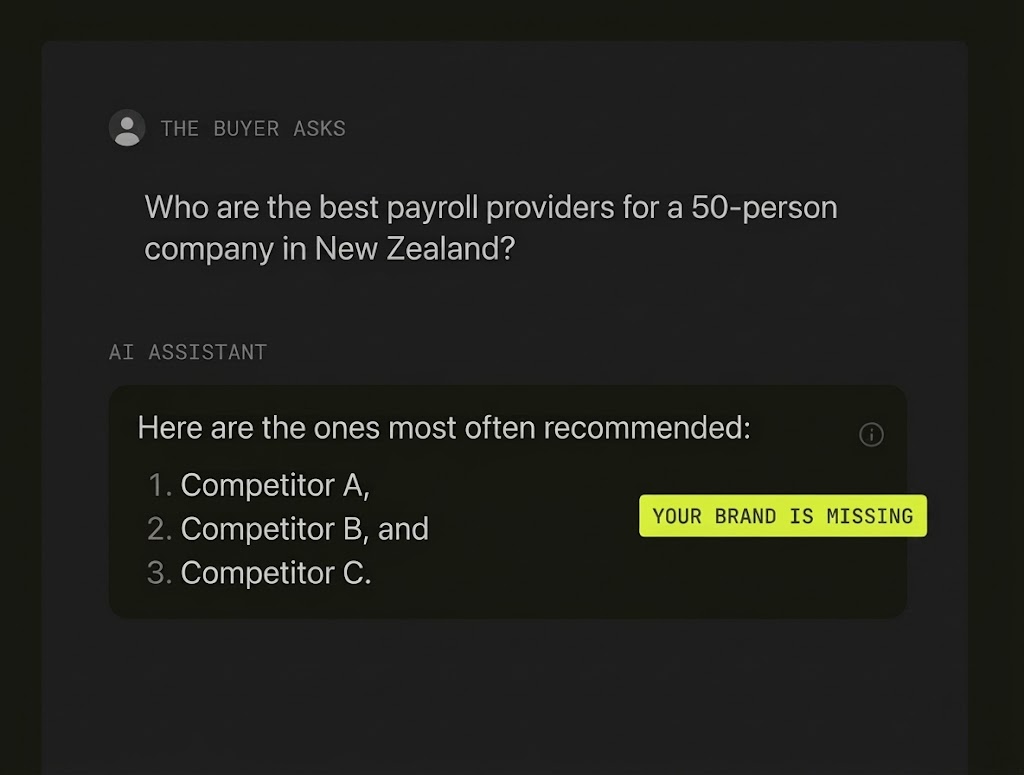
When a buyer asks today
Three brands got named.
None of them was yours.
An assistant doesn’t rank pages. It reads them, and recommends the brands it could make sense of. That buyer never sees your site, and the loss never shows up in your analytics.
How do we actually help you be in the answer?
The worked example
Meet Harbour, an example payroll company standing in for you. Follow along to see how we help them be in the answer.
Stage 1 · Audiences
Who actually buys from you?
We read your site and build a proper ICP for each audience: their situations, their worries, the words they use. We suggest, you approve.
Could you write yours from memory?
The after-hours administrator
B2B · primary“Payroll landed on me because someone had to do it, and getting it wrong isn’t an option.”
- Situations
- Runs payroll for a 12-person joinery firm on Sunday nights, between everything else · comparing software for weeks without anyone to ask.
- Anxieties
- Getting Holidays Act calculations wrong and only finding out at audit.
- Jobs to be done
- Get the pay run under an hour a week · know Holidays Act is handled without becoming an expert in it.
+ how they talk · pain points
Stage 2 · Your content
Can your pages actually be read?
We analyse every page you already have the way an assistant reads it, and turn what we find into a clear pathway of fixes. Each page gets a score, and we help you rewrite it in your own tone of voice to improve it.
Could an assistant quote your busiest page?
- 4/12
Opens with a clear answer
The lead is a slogan
- 0/8
Section titles sound like real questions
None do
- 3/10
Facts, quotes and sources to cite
One stat, unsourced
+ five more criteria · every point accounted for
Stage 3 · Ask the engines
When your buyer asks, are you in the answer?
We ask their questions across ChatGPT, Gemini, Claude and Google’s AI Overview, then analyse everything that comes back: mentions, citations, who got named instead, and the white space nobody has claimed.
Whose names come back for your category?
The administrator asks
“I do the pay run on Sunday nights and I’m never fully sure I’ve got leave right for our part-timers. Is there software that handles Holidays Act properly for a small firm, and what should I check before trusting one?”
The assistant answers
It recommends three providers, with reasons for each. Harbour isn’t one of them.
Stage 4 · Create a snapshot
How will you know anything changed?
Pick the questions that matter and save them as a snapshot. Same questions, same wording, every run from here: that is what makes movement mean something.
What would you compare next quarter to?
- 1.“I do the pay run on Sunday nights and I’m never fully sure…”
- 2.“We’re hiring our first employee and I don’t know what I’m required…”
- 3.“Our accountant has done the wages for years but she’s retiring…”
+ seven more · same questions, same wording, every run
Stage 5 · Close the gaps
Which answers are missing from your site?
That white space becomes article topics, checked against what you already have. Pick one, and we draft the answer in your tone of voice: fully AEO compliant, built to be quoted.
What’s the article only you could write?
What happens if you get Holidays Act leave calculations wrong?
Opens with the answer. Question-shaped sections. A worked example with real numbers, and sources an assistant can check.
A human edits before it goes out. That is the point of a draft
One quarter later · the same question, re-run
Same question. New answer.
October
It recommends three providers, with reasons for each. Harbour isn’t one of them.
January
“…for a small team worried about getting Holidays Act calculations right, Harbour Payroll is worth a look; their guide to leave calculations is one of the clearest explanations available.”
Named, and quoted
Run the same set again whenever you choose; we suggest quarterly. Measure, fix, publish, measure again.
Check your siteWhy we’re different
This isn’t daily
numbering.
Monitor-led tools hand you a visibility percentage that moves every morning for reasons that have nothing to do with you. You can’t fix a percentage. What you can do is set a control: save the questions that matter as a snapshot, do the work, then re-run the same set. When the answer changes, you know you changed it.
Monitor-led tools · one week
Mon
61%
Tue
58%
Wed
63%
Thu
57%
Fri
62%
Nothing on your site changed.
Your control group · one quarter
Oct
Snapshot: not named
Nov
Fix your pages
Dec
Publish the answer
Jan
Named, and quoted
Same question, and now you know why the answer moved.
What do people ask first?
What is this, in one sentence?
Most sites were built to rank on Google. Vizebel walks you through getting one ready to be quoted by AI instead: who your buyers are, what they ask, where you stand today, and the work that closes the gap.
Why does this matter if my Google rankings are fine?
Because a growing share of buyers never reach the results page. They ask an assistant and take the answer it gives. That visit never lands in your analytics, so the loss is invisible. Your rankings can look healthy while your pipeline quietly thins out.
Is this just SEO with a new name?
No, though good SEO helps. Search ranks pages and hands over ten links. An assistant writes one answer and names a handful of brands. You are trying to become the thing worth quoting, not the thing worth clicking, and that is a different job on both the content and the technical side.
Next step
Ready to find out where you stand?
Give us the address. We’ll read the site, work out your audiences and show you the questions before anything runs. Credits only get spent when you say so.